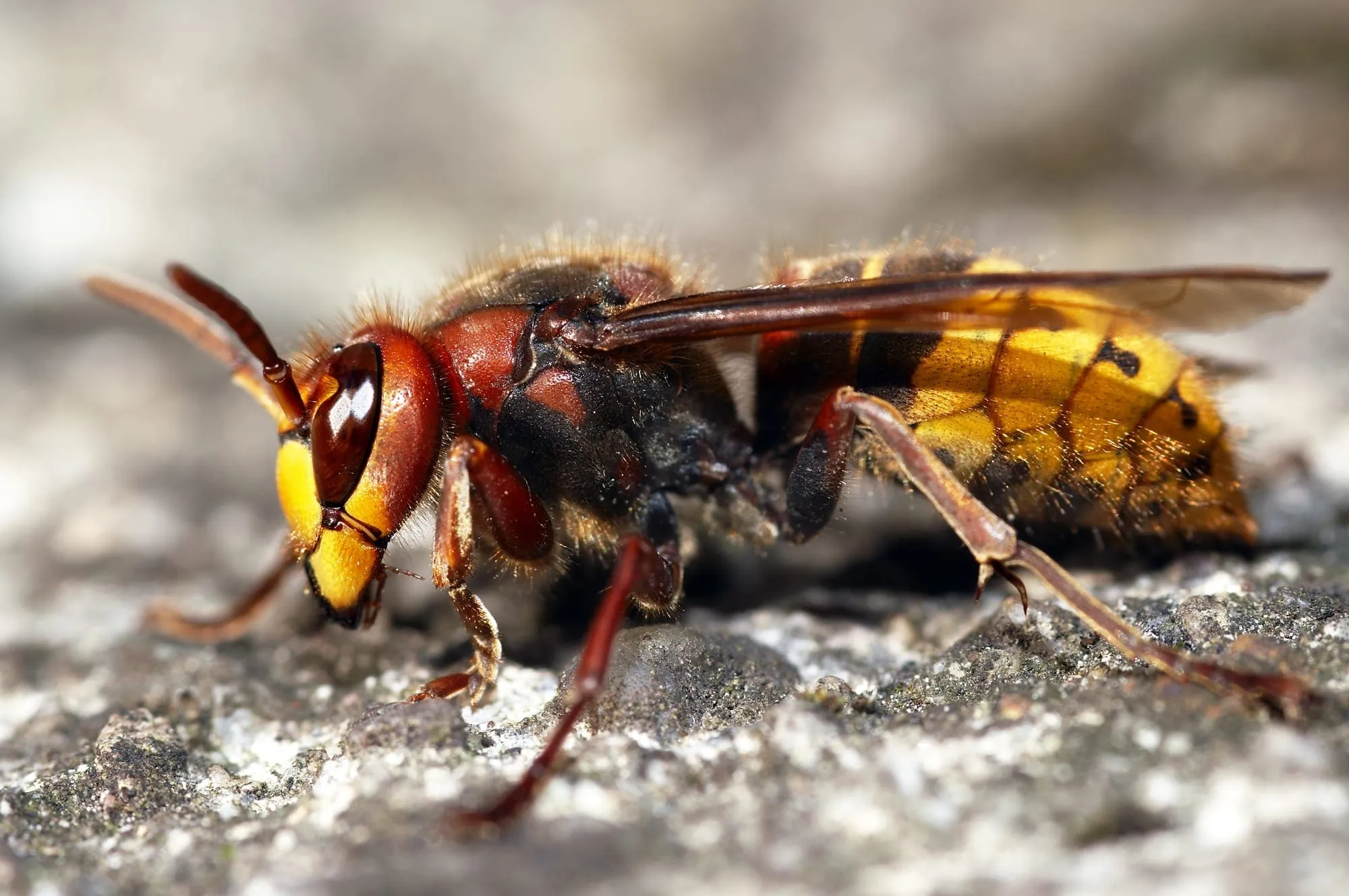
Peak heat wakes a big, fast wasp that startles a lot of East End owners. You see it hovering low over a bare, sandy patch near the patio, the beach path, or the edge of a driveway, and it looks like trouble. On most coastal lots it is a cicada killer, a large solitary wasp that digs nests in loose soil and rarely has any interest in people. Telling cicada killers from paper wasps and hornets saves a rushed call and points you to the pest that actually needs work. Owners in Southampton and Bridgehampton run into these mounds every summer once the ground warms.
This article is about identification and calm next steps, not knockdowns of a nest you have not identified yet. If the wasp you are watching is working an eave or a grill hood instead of the ground, read wasp nest scouting under eaves first, because that is a different insect with a different plan.
What a cicada killer looks like
Cicada killers are among the largest wasps you will see on the East End, often more than an inch and a half long. They have a rusty or reddish thorax, a black abdomen banded with pale yellow, and amber wings. They fly low and heavy, and the males patrol a small territory with a lot of noise and no sting. The females sting only to paralyze cicadas for their young, and they almost never turn that behavior on a person standing nearby.
The clearest sign is the ground itself. Look for a small crescent of loose soil pushed out of a pencil-width hole, often with a fan of sand spilling downhill. On a sunny bank, a driveway edge, or a thin spot in the lawn, you may find several holes a foot or two apart. Each female digs her own burrow, so a cluster of holes is many separate wasps rather than one shared nest.
Why sandy East End lots attract them
Cicada killers want bare, well drained soil that is easy to dig and sits in full sun. That describes a lot of the East End: sandy banks near dunes, the dry strip along a south facing foundation, the shoulder of a gravel drive, and any lawn thin enough to show soil. Irrigation that keeps one zone soggy pushes them toward the driest patch on the property, which is often the exact area guests cross on the way to the pool or the beach path.
The activity looks worse than it is because the timing is loud. Adults emerge in midsummer, the males spend weeks chasing each other over the same few square feet, and the whole show happens right when outdoor meals fill the calendar. Lots in Montauk and East Hampton with sandy soil and open sun see the heaviest traffic, and it fades on its own by late summer once the adults finish the season.
How they differ from paper wasps and hornets
The difference that matters is where they live and how they behave. Paper wasps and hornets build shared paper nests under eaves, in shrubs, or in wall voids, and they defend those nests as a group. Cicada killers live alone in the ground, and a male buzzing your ankle is bluff rather than threat. If the insect is coming and going from a hole in the dirt, it is almost certainly a cicada killer. If it is coming and going from a gray paper nest overhead, it is not.
Size helps too. Cicada killers are much larger than a paper wasp and lack the smooth football shaped gray nest of a bald faced hornet. When you are not sure, photograph the insect and the spot it is working from a safe distance. A shot of the ground hole tells a very different story than a shot of an eave nest, and it changes the plan. For the overhead nests, wasps and stinging insects and wasps and hornets when to call cover the real defensive species. Do not confuse either one with the loose soil piles from carpenter ants, which show up as fine frass along trim rather than mounds in the open yard.
What to do about the mounds
For most lots the honest answer is to leave them alone and let the season end. Cicada killers aerate soil and remove cicadas, and they do not chew wood or enter the house. If the holes sit in a quiet corner, mark the spot so nobody kneels on it and move on. Where they become a nuisance is a high traffic area: a play spot, a patio edge, or the sandy lane everyone walks to reach the water.
The lasting fix is turf, not spray. Cicada killers avoid thick grass and shaded, firm soil, so thickening a thin lawn and watering it evenly does more than a can from the shelf. Fill an active burrow only after dusk when the female is inside, and never over a spot where children play until you are sure the season is done. If the bare patch also holds standing water after rain or edges tall grass where ticks gather, walk the whole area with the Montauk summer pest checks so you are not fixing one zone while missing another.
When to call Hampton Pest Management
Call when the burrows sit in a walkway or play area and the traffic will not move, when someone in the household has a known sting allergy, or when you cannot tell whether you are looking at ground nesting cicada killers or a defensive colony. Those calls deserve eyes on the property rather than a guess from a ladder.
Use contact with a photo of the insect and the exact spot it is working, plus a note about how close it sits to seating or paths. If you are still sorting which summer issue to handle first, the peak summer pest symptom quiz points you to the right read. Hampton Pest Management serves the East End from Montauk through the North Fork, and the goal here is a clear identification before anyone treats the wrong pest.