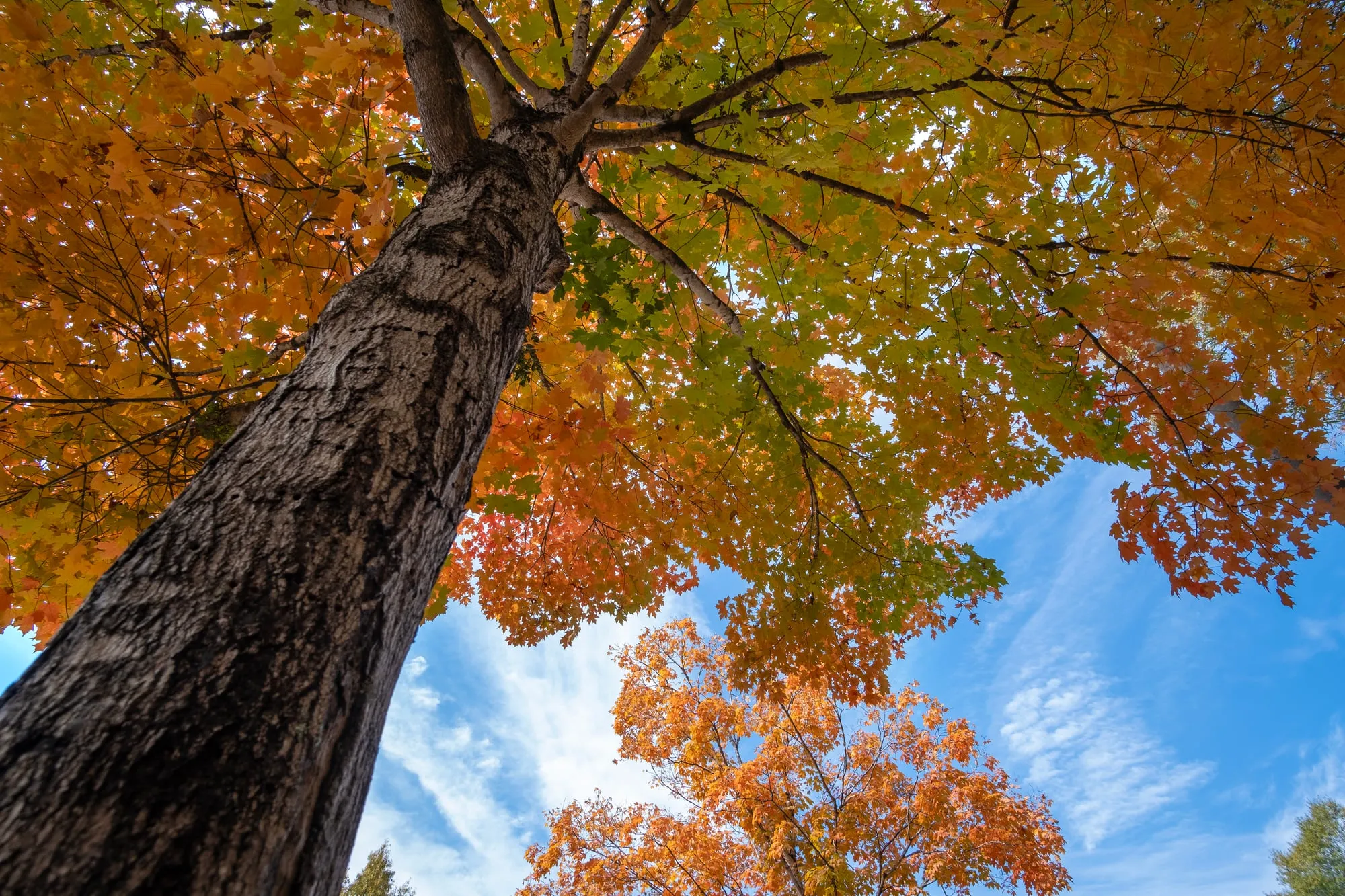
A tree can look like the problem is happening above ground.
Leaves are smaller than expected. The canopy is not filling in the way it once did. The tree simply looks less vigorous than the plants around it.
That naturally sends attention upward.
Our tree and plant health division also looks down.
One of the more specialized services we offer is Air Spade Root Revitalization. An Air Spade uses compressed air to move soil away from roots so the root zone can be inspected and worked around without approaching it like ordinary excavation.
It is not a service every tree needs. Its value comes from situations where what is happening below the soil line may explain what the homeowner is seeing in the canopy.
The base of a tree can tell an important part of the story
Trees are often planted, mulched, landscaped around, and renovated around over many years.
Soil can be added.
Mulch can build up.
A bed can be regraded.
Construction traffic can compact the ground nearby.
The tree trunk still looks like it is standing in the same place, while the relationship between the soil and roots may have changed.
Our Air Spade service can be used to expose roots, examine planting depth, and investigate soil conditions around trees showing stress.
That is useful because the root system is difficult to evaluate when it is hidden.
The goal is not to uncover every root on the property.
It is to create enough access for the plant-health professional to understand what is happening around the root flare and nearby soil.
Soil compaction is not visible from the patio
A lawn can look perfectly normal while the soil underneath is difficult for roots.
Vehicle traffic, construction work, repeated foot traffic, or years of pressure can change soil structure.
We include soil improvement and organic amendments among the possible steps associated with our Air Spade root work.
That is different from simply fertilizing a tree.
We also offer organic deep-root fertilization as a separate service, which places nutrients into the root zone.
Those services should not be treated as two names for the same thing.
One tree may need nutrition.
Another may need the root zone inspected first because we are trying to understand planting depth or soil conditions.
The assessment should decide which conversation makes sense.
A beautiful landscape can hide a poorly buried trunk
Mulch rings look tidy.
So do raised planting beds.
The problem comes when material builds up too high around the base of a tree.
A homeowner may see a clean mound of mulch while the arborist or plant-health technician sees a trunk entering the ground without the normal root flare visible where expected.
We list restoration of proper planting depth among the uses for our Air Spade service.
This is the kind of issue that can be difficult to understand from the surface.
Removing some material by hand may reveal the answer.
In other cases, a more controlled root-zone investigation can give the technician a better view of how the tree was planted and what has happened around it since.
Root work belongs inside the larger plant-health program
We are not positioning the Air Spade as an isolated landscaping gadget.
It sits inside a tree and plant health division that uses Integrated Pest Management principles and runs seasonal care programs for East End trees, shrubs, and ornamental plantings.
We also provide organic tree fertilization, deer-repellent programs, disease and pest monitoring, and other plant-health services.
That context matters.
A declining tree may have a root-zone problem.
It may have a pest issue.
It may have a disease problem.
It may be responding to several stresses at once.
There is no reason to use an Air Spade simply because we own one.
The tool becomes useful when the property evaluation gives the plant-health professional a reason to look below the surface. Our services overview describes how that evaluation-first approach fits the wider operation.
Tell the technician about construction and landscape changes
One of the best things a homeowner can provide is history.
Was a patio installed nearby?
Did a driveway project bring equipment across the root zone?
Was the bed raised?
Did a previous landscape crew add soil or mulch around the trunk?
Did the tree begin looking different after another project?
Those details can point the inspection toward the right area.
This is especially useful on established Hamptons properties where a mature landscape may have gone through several renovations while the same trees remained in place.
A technician arriving today cannot see everything that happened ten years ago.
The owner may be able to fill in part of that story. Properties across our service areas often share that pattern of mature plantings and newer hardscape work on the same lot.
Do not assume every tree problem begins in the leaves
The visible symptom is often the reason someone makes the call.
The actual investigation may move elsewhere.
That is one of the reasons our broader service process begins with evaluation and identification before treatment.
For tree and plant health, that may mean looking at foliage, bark, insects, soil, planting depth, roots, or the way the property around the tree has changed.
An Air Spade gives us a way to inspect one of the parts that is normally hidden.
We serve South Fork and North Fork communities across Long Island’s East End. Browse all services, or contact the team. Property owners can call the main office at (631) 728-1708 to discuss tree and plant health care or whether a root-zone evaluation fits what they are seeing.